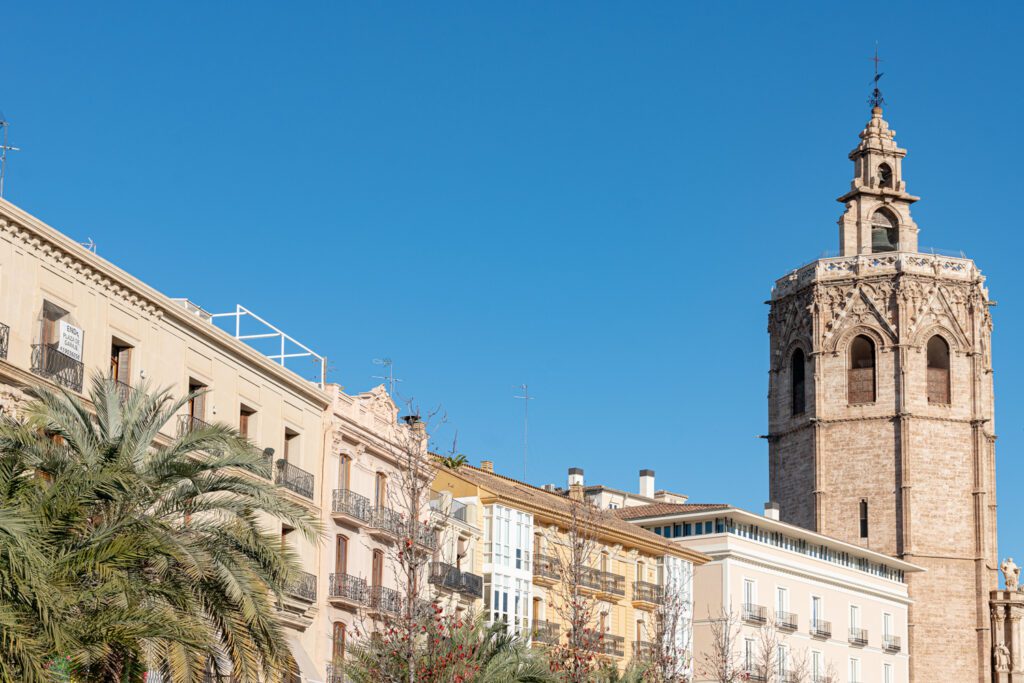
The Plaza de la Virgen is one of the most iconic and oldest squares in Valencia. It stands out as the most historic of the three squares in the city center, along with Plaza de la Reina and Plaza del Ayuntamiento, all located along the same axis that runs through the heart of the city.

The Roman origin of the square
Located in the heart of Ciutat Vella (Old Town), the Plaza de la Virgen is the nerve center of Valencia, mainly because it marks the spot where the city’s history began. This square sits roughly on what was once the roman forum, the original core of Valencia’s Roman foundation. Just a short distance away, in Plaza Décimo Junio Bruto, you’ll finde the Almoina Archeological Park, where visitors can explore the remains of Roman Valencia and gain deeper undestanding of its origins.
In roman times, the streets we now know as Caballeros and San Vicente Mártir were the Decumanus and the Cardus Maximus, the two main roads that structured every Roman city. These streets intersected exactly at the forum, which now lies beneath Plaza de la Vigen. From this point, the city began to expand, both during the Muslim period and later in the Christian era.

The Middle Ages and the urban centre
During the Christian period, it became known as Plaza de la Seu due to the presence of Valencia’s cathedral, commongly called la Seu, a term derived frome the Latin sed, reffering to the bishop’s seat. In the Middle Ages, the heart of the city was organized around the cathedral, which made Plaza de la Virgen the epicenter of urban life and the place where some of Valencia’s most important buildings were located.
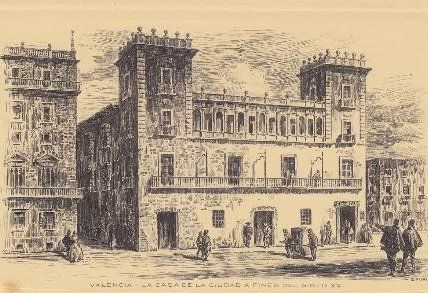
Among theses buildings stands the Palau de la Generalitat, built between the 15th and 16th centuries, which still rises majestically between the square and Caballeros street. Beside it once stood the Casa de la Ciudad, Valencia’s former town hall. Although the building was demolished in the 19th century, its legacy lives on in the adjacent garden that now occupies its place offering a peaceful corner next to the Palau de la Generalitat and Plaza de la Virgen.
Symbols of devotion and prosperity
However, the building that gives the square its current name, the Basilica de la Virgen de los Desamparados (Our Lady of the Forsaken), wasn’t constructed until the 17th century. Located right in the heart of the square, this oval-shaped basilica houses the image of the patroness saint of Valencia, a figure venerated for more than 500 years. The image was originally kept in the Cathedral, but during the Early Modern period it was decided to build this unique temple to honor Our Lady of the Forsaken, the most beloved religious figure among Valencians. The basilica’s decoration includes an impressive frescoed dome painted by Antonio Palomino, court painter to King Carlos II, which adds a sense of devotion and divinity to the space.
The last notable feature of the square is the Turia Fountain, installed in the second half of the 20th century. The fountain is dominated by an imposing figure of Neptune, an allegory of the Turia River, holding a cornucopia symbolizing prosperity. The figure reminds us that the waters of the Turia bring fertility to the city, irrigating Valencia’s vast plain. Surrounding Neptune are eight nymphs, representing the major irrigation canals that distribute water across the region’s fields, highlighting the importance of this irrigation system in the area’s high agricultural productivity.

Traditional events in the square
t’s no coincidence that this fountain is located in Plaza de la Virgen, since right here, in front of the Apostles’ Gate of the Cathedral, the Tribunal de las Aguas (Water Court) meets every Thursday. This court, the oldest functioning legal institution in Europe, is responsible for regulating the use and management of the Turia’s water. Its rulings are delivered orally and in Valencian, without any written record. Its age and uniqueness make it one of the most closely followed events for both locals and visitors.
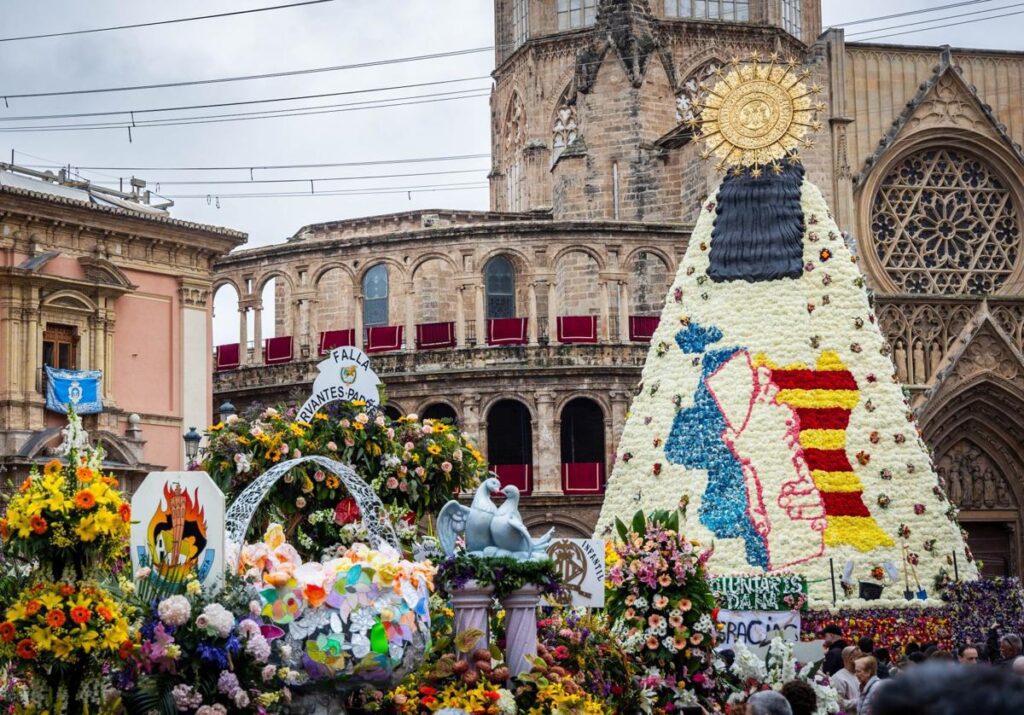
The Plaza de la Virgen is also the stage for several major traditional events. During Fallas in March, the Offering to the Virgin takes place here, one of the most emotional moments of the festival. Thousands of falleros and falleras parade to the square carrying bouquets of flowers to decorate a large image of the Virgin, which is covered with more than 100,000 bouquets of carnations, daisies, and floral panels, creating an impressive mantle of flowers.
Another important event is the Feast of Our Lady of the Forsaken, held on the second Sunday of May. On this day, the Virgin is carried from the basilica to the cathedral, and thousands of Valencians gather in the square to honor the city’s patron saint. It is a moment of deep religious devotion, where tradition and faith come together in an atmosphere filled with emotion and fervor.
Access to the square and its stops
Since Plaza de la Virgen is right in the center of Valencia, it’s easiest to reach on foot, as neither the metro nor the bus passes directly through this area. You can get there via Caballeros Street, which runs from the Torres de Quart all the way to the square. If you’re coming from Plaza del Ayuntamiento, the best route is to take San Vicente Mártir Street to Plaza de la Reina, and from there continue on to Plaza de la Virgen. Another option is to take bus 95, which runs along the Turia Gardens—known locally as ‘the River’—and get off near the Torres de Serranos, just a 5-minute walk from the square.
Once in the square, after admiring the monuments described above, you can relax at one of its many terraces and enjoy a coffee or ice cream while taking in the views of this iconic spot in the city. If you’re looking for something livelier, head to Café de las Horas on a nearby street, where you can try the city’s famous cocktail, Agua de Valencia. If you’re hungry, you can have breakfast or lunch at Brunch Corner, located on one of the square’s corners, or if you want something more traditional, visit Taberna La Samorra, just a one-minute walk away on Almudín Street.